Despite the poor productivity and retail sales report, gold and silver were hammered at the end of the European close. News came out from King World News that it was the BIS (Bank of International Settlement) which bailed out a heavy short position by a major financial institution which increased their short positions shortly after the "awesome" jobs report on Friday,
But the short position soon turned into a nightmare as gold spiked after the productivity report and spiked again after the retails sales report. We can assume it was an attempt to bail out a troubled financial institution.
Looking back we had a similar action in April where a financial institution(s) dumped more than US$2.0B worth of paper gold. The interesting twist is that this time it required US$5.0B to effect a similar downward movement in price.
If anything, it showed that the central bankers are getting more and more desperate in their attempt to suppress the price of gold and silver.
Zerohedge had two very interesting reports. The first report concerns the income tax receipts which fell from a 13.4% y-o-y growth in June 2013 to 1.2% growth y-o-y in June 2016 (see chart by Zerohedge).
As can be seen, the chart is showing a very precarious trend. If the trend continues into negative territory - and that is a strong possibility given the continual weak earnings and growth in minimum wage jobs - we could likely see a recession in the coming months.
The other is a report where Turkey's President threatened to abandon the US$ on its trade with Russia. The lean towards Russia by Turkey could result in a major black swan event.
Meanwhile, I continue to be bullish on precious metals, miners and related ETFs.
Use of information contained in this blog does not constitute any contractual relationship between the reader and the author. The author hereby disclaims all responsibilities and liabilities for any use of information contained in this blog. Readers are advised to exercise due diligence and do their own assessment of the risks involved when investing in any company. Readers shall not hold the author liable for investments which have gone sour.
Sunday, August 14, 2016
Thursday, August 11, 2016
US PRODUCTIVITY DISAPPOINTS WHILE INVENTORIES TO SALES RATIO REMAINS HIGH
After last week's hammering of gold and silver due to the "awesome" jobs report, this week saw precious metals and miners bounced off their lows to resume their upward momentum, driven in particular by a poor productivity report and an inventories to sales ratio that remains high.
US Nonfarm Productivity came in at -0.5% vs +0.5% expected, off by a wide margin of -1%. This followed a previous month's productivity of -0.6% in June.
The Inventories to Sales ratio remain high which in previous periods have been a recessionary period.
Source: Zerohedge
The US could possibly be in a recession despite the continual denial by the Fed and government and that everything was "awesome".
The auto inventories is cresting upwards as car sales continue to slow down. Even Ford is warning that Q3 results may disappoint.
Source:; Zerohedge
As I mentioned last week, consumer spending is being threatened by low paying jobs. Most of the spending so far is driven by subprime auto loans and consumer credit. Amount of consumer credit and auto loans outstanding is more than a trillion dollars each. And this is a dangerous sign.
Friday, August 5, 2016
ANOTHER "AWESOME" JOBS REPORT DUE TO ADJUSTMENTS BUT RATE HIKE IS STILL A CHALLENGE
After June's "awesome" jobs report, July's report extended the "awesomeness" by another staggering 255,000 jobs, despite the sluggish GDP growth in Q1 and Q2, and against the backdrop of declining earnings in the S&P, the index crested to yet another record.
Economic fundamentals are thrown out of the door as important indicators are ignored as traders and investors cheered the "adjusted" jobs report very much like the cheering of adjusted non-GAAP earnings.
Now, here's an interesting twist to July's jbs report. As reported by Zerohedge, Mitsubishi UFJ strategist John Hermann wrote that the "jobs headline overstates"the strength of the payrolls. he adds that unadjusted data show a "middling report that is nowhere as strong as the headline". He adds that the unadjusted private payrolls was +87,000 in July vs the seasonally adjusted figure of +217,000.
So did the BLS overstate the jobs report in support of the government, precisely during this election year?
Recent reports which seem to indicate the opposite. For example the amount of withholding tax in personal income has dropped 1% in July. This could be explained by :
1) A drop in actual jobs number or
2) A drop in high income jobs, and replacement in numbers are insignificant to raise the withholding tax.
Which brings us to the issue of consumer spending. If the personal withholding tax has dropped it means that the personal income earned has dropped as well. So how can a drop in personal income be positive for consumer spending. Consumer spending seems to be driven by debt as student loans, auto loans and consumer credit reached historic highs (See usdebtclock.org).
It the same report, corporate income tax has declined more than 10% as companies' earnings fell. You can bet on it that it will just be a matter of time before US companies begin another massive layoff.
Also, with the revenue from taxes falling, the US would have to rely on more debt to finance the government. Looking at usdebtclock.org, the amount of trade deficit has hit more than US$700B YTD. Coupled with the deficit spending by the government which number about US$500B a year, the US looks on track to deliver yet another US1T in total deficit by end of the year, which will result in another US$1T being added to the national debt.
Incidentally, the jobs headline obscured the trade report which showed the US had a trade deficit in July which was worse than expected.
So will the "awesome' report push the Fed to decide on a rate hike? I think NOT by a long shot. The ECB, BOJ, BOE are all having QE on steroids, with the PBOC pushing for even more easing to reboot China's economy. Having a rate hike risk pushing the US economy into severe recession (but it will come eventually despite what the Fed is attempting to prevent) as the US$ strengthens, thus affecting the profitability o f US companies further, on top of having the need to service the incredulous debts accrued n the last few years.
An interest rate hike will result in many of the over leveraged companies having liquidity problems as will the US government which needs to pay interests on its US$19T debt.
Given sch a scenario, I think there is unlikely to be any rate hike.
The jobs report changes nothing. EU banks remain in crisis, China and Japan continue to see some severe economic fallout, and the geopolitical crisis in the Mideast, EU and South China Seas look set to deteriorate further.
I still believe the only safe trade or investment is still in precious metals, miners and related ETFs.
The above is entirely my opinion.
Economic fundamentals are thrown out of the door as important indicators are ignored as traders and investors cheered the "adjusted" jobs report very much like the cheering of adjusted non-GAAP earnings.
Now, here's an interesting twist to July's jbs report. As reported by Zerohedge, Mitsubishi UFJ strategist John Hermann wrote that the "jobs headline overstates"the strength of the payrolls. he adds that unadjusted data show a "middling report that is nowhere as strong as the headline". He adds that the unadjusted private payrolls was +87,000 in July vs the seasonally adjusted figure of +217,000.
So did the BLS overstate the jobs report in support of the government, precisely during this election year?
Recent reports which seem to indicate the opposite. For example the amount of withholding tax in personal income has dropped 1% in July. This could be explained by :
1) A drop in actual jobs number or
2) A drop in high income jobs, and replacement in numbers are insignificant to raise the withholding tax.
Which brings us to the issue of consumer spending. If the personal withholding tax has dropped it means that the personal income earned has dropped as well. So how can a drop in personal income be positive for consumer spending. Consumer spending seems to be driven by debt as student loans, auto loans and consumer credit reached historic highs (See usdebtclock.org).
It the same report, corporate income tax has declined more than 10% as companies' earnings fell. You can bet on it that it will just be a matter of time before US companies begin another massive layoff.
Also, with the revenue from taxes falling, the US would have to rely on more debt to finance the government. Looking at usdebtclock.org, the amount of trade deficit has hit more than US$700B YTD. Coupled with the deficit spending by the government which number about US$500B a year, the US looks on track to deliver yet another US1T in total deficit by end of the year, which will result in another US$1T being added to the national debt.
Incidentally, the jobs headline obscured the trade report which showed the US had a trade deficit in July which was worse than expected.
So will the "awesome' report push the Fed to decide on a rate hike? I think NOT by a long shot. The ECB, BOJ, BOE are all having QE on steroids, with the PBOC pushing for even more easing to reboot China's economy. Having a rate hike risk pushing the US economy into severe recession (but it will come eventually despite what the Fed is attempting to prevent) as the US$ strengthens, thus affecting the profitability o f US companies further, on top of having the need to service the incredulous debts accrued n the last few years.
An interest rate hike will result in many of the over leveraged companies having liquidity problems as will the US government which needs to pay interests on its US$19T debt.
Given sch a scenario, I think there is unlikely to be any rate hike.
The jobs report changes nothing. EU banks remain in crisis, China and Japan continue to see some severe economic fallout, and the geopolitical crisis in the Mideast, EU and South China Seas look set to deteriorate further.
I still believe the only safe trade or investment is still in precious metals, miners and related ETFs.
The above is entirely my opinion.
Wednesday, August 3, 2016
PRECIOUS METALS HAMMERED AHEAD F THE JOB REPORT ON FRIDAY
I see increasing desperation among the bullion banks which have built a huge position to short gold and silver just before BREXIT and the US GDP report only to see gold and silver increased in price.
Now, at every small opportunity to short the precious metals they are at it everytime such as a positive S&P, Nikkei and Dax reading and the recent ADP report which can diverge from the Non Farm Payroll due this Friday.
So expect to see some pressure on precious metals going into the Friday jobs report.
I think it will not be spectacular with a lower revision for June report. This is because the recent Manufacturing and Services reports are showing reduced jobs for construction and services.
Still, the headwinds are just short term and we should see the larger picture; ie: EU'S banking crisis, the US Presidential Elections and the geopolitical and economic crises worldwide.
Now, at every small opportunity to short the precious metals they are at it everytime such as a positive S&P, Nikkei and Dax reading and the recent ADP report which can diverge from the Non Farm Payroll due this Friday.
So expect to see some pressure on precious metals going into the Friday jobs report.
I think it will not be spectacular with a lower revision for June report. This is because the recent Manufacturing and Services reports are showing reduced jobs for construction and services.
Still, the headwinds are just short term and we should see the larger picture; ie: EU'S banking crisis, the US Presidential Elections and the geopolitical and economic crises worldwide.
Tuesday, August 2, 2016
SIGNS THAT A FINANCIAL CRISIS IS JUST AROUND A CORNER?
The EU stress test was supposed to soothe investors' worries.
Then again... what stress test if these are the aftermath of it?
Charts are from Zerohedge.
An imminent crisis around the corner? You bet!

Will the Italian banks be the trigger? French banks have the most exposure.


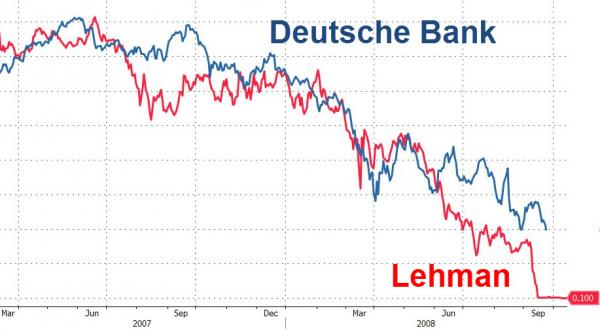
Then of course there's Deutsche Bank which is mirroring Lehman's trajectory.
Then again... what stress test if these are the aftermath of it?
Charts are from Zerohedge.
An imminent crisis around the corner? You bet!

Will the Italian banks be the trigger? French banks have the most exposure.


Then of course there's Deutsche Bank which is mirroring Lehman's trajectory.
Saturday, July 30, 2016
SOMETHING EXCITING COULD HAPPEN TO GOLD
There have been many news circulating about gold recently that were hardly reported in the mainstream news media.
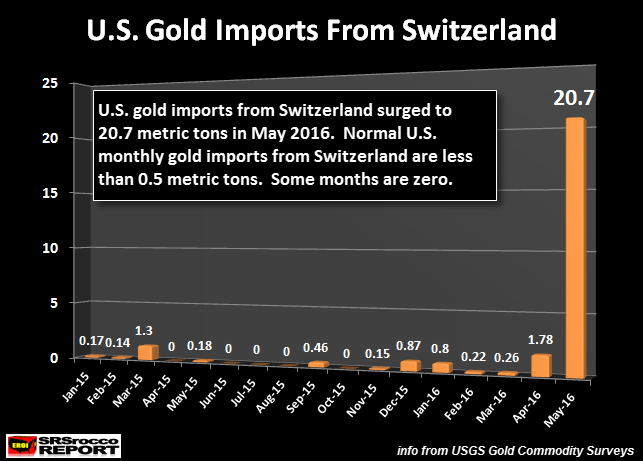
One such news is a report from SRSrocco which showed record amount of gold being exported from Switzerland to the US (See chart below)

Have the investors community in the US finally begun their move into gold? Currently, only 1% of the public invest in gold. Now imagine what will happen when that 1% grows to 2%. The chart above could indicate a change of investors' preference for the yellow metal. It will be interesting to watch if the chart is a one time off event or the beginning of a longer trend.
Hot in the news is the Tokyo Commodity Exchange's (TOCOM) pivot into physical settlement, much like the Shanghai Gold Exchange.Recently it was reported that Tanaka Holdings, one of Japan's primary gold dealers has acquired shares of Metalor, a Swiss precious metals refiner. The purchase of Metalor will result in Tanaka gaining access into the in the precious metals recovery and refining business in Europe, North America and Asia.
The Tanaka's purchase and TOCOM's decision could shift the pricing power from the West to the East, which will also dent the power of the COMEX to influence pricing.
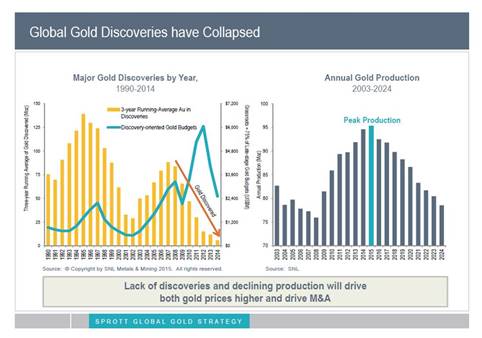
Lastly, here's another chart from Marketwatch, which shows that gold discoveries and production are expected to fall off the cliff in the coming years. This could cause a huge re-pricing of gold on the upside.

One such news is a report from SRSrocco which showed record amount of gold being exported from Switzerland to the US (See chart below)

Have the investors community in the US finally begun their move into gold? Currently, only 1% of the public invest in gold. Now imagine what will happen when that 1% grows to 2%. The chart above could indicate a change of investors' preference for the yellow metal. It will be interesting to watch if the chart is a one time off event or the beginning of a longer trend.
Hot in the news is the Tokyo Commodity Exchange's (TOCOM) pivot into physical settlement, much like the Shanghai Gold Exchange.Recently it was reported that Tanaka Holdings, one of Japan's primary gold dealers has acquired shares of Metalor, a Swiss precious metals refiner. The purchase of Metalor will result in Tanaka gaining access into the in the precious metals recovery and refining business in Europe, North America and Asia.
The Tanaka's purchase and TOCOM's decision could shift the pricing power from the West to the East, which will also dent the power of the COMEX to influence pricing.
Lastly, here's another chart from Marketwatch, which shows that gold discoveries and production are expected to fall off the cliff in the coming years. This could cause a huge re-pricing of gold on the upside.

Friday, July 29, 2016
US GDP GREW WORSE THAN EXPECTED AND QE4 WITH NIRP COULD BE COMING
US GDP grew a paltry 1.2% in Q2 2016 with Q1 GDP being revised down to 0.8% from 1.1% earlier.
In a worst reading of Q2 GDP since 2010, we saw the US$ tanking which boosted the price of precious metals and crude oil and the S&P touching an all time high! The insanity in the price movement of the S&P knows no bounds as expectations of quarterly earnings continue to deteriorate in Q2. Despite the increase in drilling rigs count, crude oil climbed. I would expect crude oil to trend downwards in the coming weeks as we saw the continual buildup of gasoline and storage at Cushing despite this being the peak summer period. If anything, it points to fact that US citizens have far less to spend than the ordinary summer months, and this could reflect on another disappointing GDP data in Q3.
And about that mind blowing June jobs report, be prepared that it could be revised lower too.
I think The Fed is aware of this too, therefore its unwillingness to raise interest rates although it did say that the short term risks have diminished. Let's face the fact, with slowing GDP growth, any rate hike will be devastating for the highly leveraged shale oil plays, the corporations which borrowed trillions of US$ on the cheap and a struggling US government, burdened by huge deficit spending and an escalating debt which could reach US$20 trillion by the end of the year. On top of that, we have a trillion each in consumer debts, student loans and auto loans. Remember the car sales that kept rising higher and higher? Well, its driven substantially by subprime car loans.
Against such a backdrop, I think QE4 and NIRP could be coming to the US. Here's what Zerohedge reported:
As of February, Yellen had not “fully investigated” the legal issues of negative rates.
As of May, Yellen was unwilling to state the Fed had legal authority to go negative.
As of June, Yellen had no doubt the Fed could legally go negative.
So you see, the legality of NIRP is resolved. The Fed could use NIRP if the Fed deems fit.
If that happens the monetary debasement could be huge.
If you have not owned any precious metals and related mining stocks, perhaps you should really consider it before all hell breaks loose. If that happens many will be priced beyond your reach.
The above is just my opinion.
Subscribe to:
Posts (Atom)