Read it here:
http://www.zerohedge.com/news/2015-11-11/energy-credit-risk-spikes-back-above-1000bps-no-one-putting-new-capital-here
Wednesday, November 11, 2015

EIA: US SHALE OIL PRODUCERS COULD SEE PRODUCTION DROP BY 118,000 BOPD IN DECEMBER
According to the EIA, US shale oil production could see a drop of 118,000 bopd in December.
Taking into consideration that US shale oil production has dropped approximately 500,000 bopd from April to October (reported by oilprice.com on 25 October), we could potentially see a combined drop of more than 600,000 bopd in shale oil production as we enter into 2016.
This far surpassed Citigroup's estimated drop of 500,000 bopd by the end of the year. The drop could be more pronounced as we enter Q1 2016. This is supported by the fact that US rigs count has dropped for the last 10 weeks, and further capex has been differed or cancelled.
Will continued drop in US production push oil price northwards?
I am inclined to believe so, even with Iran coming into the picture. This is because Iranian oil needs investment from major oil companies to kickstart its oil ambition and right now all oil majors have no intention to commit further capex in either oil exploration or oil field development.
According to Marketwatch (reported on 10 November), more than US$200 billion of energy projects have been cancelled thus far. So I believe it is unlikely that Iran would be able to secure enough investments to develop its oil fields in order for it to meet its targeted production in 2016.
In such a scenario, oil price could finally stabilise. I believe by Q1 2016, we could see oil price above US$50 a barrel.
The above is just my opinion. You are encouraged to do your own research.
Link: http://www.kallanishenergy.com/2015/11/11/shale-oil-production-drop-118000-bpd-eia/
Taking into consideration that US shale oil production has dropped approximately 500,000 bopd from April to October (reported by oilprice.com on 25 October), we could potentially see a combined drop of more than 600,000 bopd in shale oil production as we enter into 2016.
This far surpassed Citigroup's estimated drop of 500,000 bopd by the end of the year. The drop could be more pronounced as we enter Q1 2016. This is supported by the fact that US rigs count has dropped for the last 10 weeks, and further capex has been differed or cancelled.
Will continued drop in US production push oil price northwards?
I am inclined to believe so, even with Iran coming into the picture. This is because Iranian oil needs investment from major oil companies to kickstart its oil ambition and right now all oil majors have no intention to commit further capex in either oil exploration or oil field development.
According to Marketwatch (reported on 10 November), more than US$200 billion of energy projects have been cancelled thus far. So I believe it is unlikely that Iran would be able to secure enough investments to develop its oil fields in order for it to meet its targeted production in 2016.
In such a scenario, oil price could finally stabilise. I believe by Q1 2016, we could see oil price above US$50 a barrel.
The above is just my opinion. You are encouraged to do your own research.
Link: http://www.kallanishenergy.com/2015/11/11/shale-oil-production-drop-118000-bpd-eia/
Monday, November 9, 2015
IS THE RATE HIKE IMMINENT?
Since 2009, the US government has raised the debt limit 6 times, increasing it by US$5,709B to US$18,113 to date.
Taking this into consideration, US tax receipts is not enough to cover the the government expenditure, and thus the need to raise debt to cover the difference. With US$5,709B raised since 2009 at near zero interest rate, any interest rate hike will not only increase the borrowing costs for the government as the US will likely to continue issuing debts to cover its own shortfall.
When the amount runs into trillions of US$, the interest payment will be a nightmare. So will the Federal Reserve take on a hawkish stance knowing that it could cause a ripple effect which will result in heavier borrowing costs for the US and impact upon its trade balances as US made goods become expensive in the global market?
Just today the OECD trimmed the global economy outlook to 2.9% vs 3.3% previously. Therefore a potential interest rate hike could tip the outlook below 2.9%.
China meanwhile released its export and import numbers which were far from impressive. Exports dropped 6.9% while import fell 18.8%. The trade surplus widened US$61.64B. The trade imbalance with US could widen further should the US$ continue to strengthen.
Maersk also reiterated recently that global GDP is worse than forecast based on their knowledge of the amount of goods shipped globally.
Against such a backdrop, I am compelled to opine that a rate hike should not happen. But the Federal Reserve's reputation is at stake. So I think a rate hike, while not imminent, could be possible, just so the proponents of a rate hike stay of f its back. It will be followed by a long pause before any rate hike kicks in again.
The above is just my opinion of course.
Taking this into consideration, US tax receipts is not enough to cover the the government expenditure, and thus the need to raise debt to cover the difference. With US$5,709B raised since 2009 at near zero interest rate, any interest rate hike will not only increase the borrowing costs for the government as the US will likely to continue issuing debts to cover its own shortfall.
When the amount runs into trillions of US$, the interest payment will be a nightmare. So will the Federal Reserve take on a hawkish stance knowing that it could cause a ripple effect which will result in heavier borrowing costs for the US and impact upon its trade balances as US made goods become expensive in the global market?
Just today the OECD trimmed the global economy outlook to 2.9% vs 3.3% previously. Therefore a potential interest rate hike could tip the outlook below 2.9%.
China meanwhile released its export and import numbers which were far from impressive. Exports dropped 6.9% while import fell 18.8%. The trade surplus widened US$61.64B. The trade imbalance with US could widen further should the US$ continue to strengthen.
Maersk also reiterated recently that global GDP is worse than forecast based on their knowledge of the amount of goods shipped globally.
Against such a backdrop, I am compelled to opine that a rate hike should not happen. But the Federal Reserve's reputation is at stake. So I think a rate hike, while not imminent, could be possible, just so the proponents of a rate hike stay of f its back. It will be followed by a long pause before any rate hike kicks in again.
The above is just my opinion of course.
WHAT BANKING GIANTS NEED TO DO TO PREVENT ANOTHER LEHMAN LIKE CRISIS
This article by Bloomberg is an interesting read.
The Financial Stability Board (FSB) created in the aftermath of the Global Financial Crisis announced that the most systematically important lenders must have total loss-absorbing capacity equivalent to at least 16% of risk-weighted assets in 2019, rising to 18% in 2022. A leverage ratio requirement will also be imposed, rising from 6% initially to 6.75%.
Pay attention to the statement that including China's 4 major banks, the banking giants of the world need to raise additional 457B Euros to 1.1T Euros. Excluding the big in China, the amount they need to raise is 107B Euros to 776B Euros. (You can then imagine how much capital the 4 China banks need to raise and appreciate the challenge confronting the Chinese banks).
It is the view of the FSB that 2/3 of the 30 major lenders of the world will need to raise additional capital to meet the new standards.
Link: http://www.bloomberg.com/news/articles/2015-11-09/banking-giants-learn-cost-of-preventing-another-lehman-moment
The Financial Stability Board (FSB) created in the aftermath of the Global Financial Crisis announced that the most systematically important lenders must have total loss-absorbing capacity equivalent to at least 16% of risk-weighted assets in 2019, rising to 18% in 2022. A leverage ratio requirement will also be imposed, rising from 6% initially to 6.75%.
Pay attention to the statement that including China's 4 major banks, the banking giants of the world need to raise additional 457B Euros to 1.1T Euros. Excluding the big in China, the amount they need to raise is 107B Euros to 776B Euros. (You can then imagine how much capital the 4 China banks need to raise and appreciate the challenge confronting the Chinese banks).
It is the view of the FSB that 2/3 of the 30 major lenders of the world will need to raise additional capital to meet the new standards.
Link: http://www.bloomberg.com/news/articles/2015-11-09/banking-giants-learn-cost-of-preventing-another-lehman-moment
Thursday, November 5, 2015
IS ASIA HEADING INTO A DEFLATION?
Is Asia heading into a deflationary economy? This is perhaps the reason why central banks in Asia are on an easing mode to stimulate growth and hence inflation. But the drag seems to continue. Deflation is harder to combat vs inflation. Japan for example has been battling it for 25 years. And now Abenomics, after the initial burst, seems to fall behind the BOJ's targets. Worse still EU countries are displaying similar patterns. Just my opinion of course, but it pays to be mindful about global events taking place.
Chart source: elliotwave.com
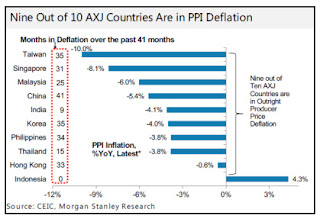
Chart source: elliotwave.com

Wednesday, November 4, 2015
LGO UPDATE
LGO reported that the loss of Well 678 could amount to approximately US$4 million. Nevertheless, LGO continues to meet its payment commitments to BNP Paribas as planned.
The company is now looking at several options to bridge the funding gap that the loss has created. This includes the appointment of Wellford Capital Markets LLC and Height Securities to jointly advise on strategic investments int he business. both will be retained for a period of 3 months and will work with the management to define options for longer sustainability, including sourcing strategic investors and the possible refinancing of the existing bank loan.
Operations at Goudron Field will continue with operating costs continuing to be met from production revenue, funds held by LGO and those being released by the bank.
Production in Spain improved to 186 bopd after well cleanout works in the summer. group production currently stands at 896 bopd due to continuing depletion in the field and slowing of work on the Gourdon Sandstone programme.
No doubt the setback had dealt a cruel blow to LGO's ambitions, but with more than 800 million of oil in place, it is just a matter of getting the funding going again to get production moving. I remain cautiously optimistic that LGO will get its act together, and with the eventual increase in oil price int he coming months, this setback will a thing of the past. still investing in UK AIM stocks is a high risk affair and it is important that you do your own due diligence.
My disclosure: I own LGO shares.
A PRECLUDE TO A FINANCIAL STORM TO IN ASIA?
Standard Charted has a strong foothold in Asia, where it has a presence for over a hundred years. Asia has always been a part of Standard Charted's core business.
In Q3, Standard Charted reported a loss of US$139 million due to impairment costs amounting US$1,230 million. The majority of the impairment costs are loan related. That it a hefty write off and perhaps is a signal that all is not well in Asia.
Now, Standard Charted needs to raise additional capital amounting to US$5.1 billion and cut 15,000 jobs globally.
If anything, it goes to show that Asia could register more defaults in coming months, brought on by a strengthening US$, low commodity prices, and asset bubbles.
Read it all here: http://www.bloomberg.com/news/articles/2015-11-04/standard-chartered-s-bad-loans-reveal-cracks-in-asian-economies
In Q3, Standard Charted reported a loss of US$139 million due to impairment costs amounting US$1,230 million. The majority of the impairment costs are loan related. That it a hefty write off and perhaps is a signal that all is not well in Asia.
Now, Standard Charted needs to raise additional capital amounting to US$5.1 billion and cut 15,000 jobs globally.
If anything, it goes to show that Asia could register more defaults in coming months, brought on by a strengthening US$, low commodity prices, and asset bubbles.
Read it all here: http://www.bloomberg.com/news/articles/2015-11-04/standard-chartered-s-bad-loans-reveal-cracks-in-asian-economies
Subscribe to:
Posts (Atom)